
Episode 4: What Do You Stand For? Why Identity Matters More Than Strategy
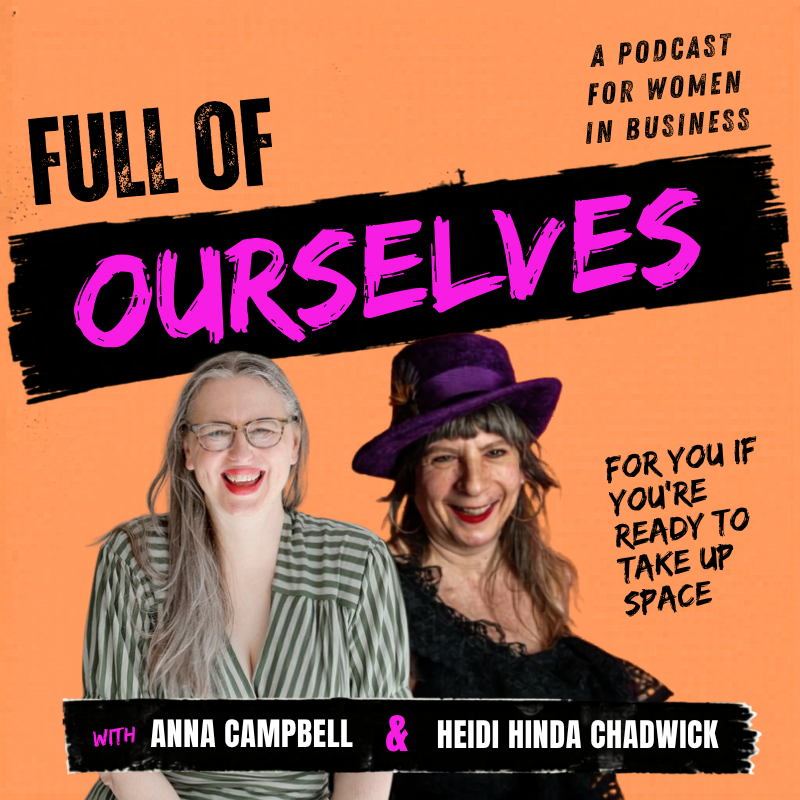
What do you stand for? It's a bigger question than "What do you do?" and one that can transform your business and life. In this episode of Full of Ourselves, Anna Campbell and Heidi Hinda Chadwick explore why identity matters more than strategy, how your values shape your decisions, and why standing for something gives you the confidence to build a business that feels truly aligned. They also share a simple but powerful exercise to help you uncover what really matters to you.
listen now
Here are the ways to listen to the podcast


watch this episode on youtube
When someone asks what you do, how easy is it to answer?
For many multi-passionate women, founders and creatives, fitting everything into a neat elevator pitch can feel almost impossible. You might be a coach, writer, speaker, artist, consultant or business owner. Perhaps you work across several different areas, all of which matter to you. Trying to reduce that complexity to one tidy job title can leave you feeling as though you are cutting off important parts of yourself.
But what if the better question is not “What do you do?”
What if it is:
“What do you stand for?”
In this episode of the Full of Ourselves podcast, Anna Campbell and Heidi Hinda Chadwick explore why knowing what you stand for can be more powerful than defining yourself by a job title, niche or business strategy.
They discuss personal identity, values-led business, self-trust, visibility and the courage required to bring more of who you really are into your work.
Your work can have many branches
A business title describes what you currently do. What you stand for explains the deeper thread running through all of it.
You might offer coaching, workshops, speaking, writing, courses, events or one-to-one work. These are the branches of the tree. What you stand for is the trunk — the steady purpose holding everything together.
When you are rooted in that purpose, you do not have to force every part of your work into one narrow category. You can experiment, grow and create new offers without losing your sense of identity.
The format may change. The message remains.
This is especially important for multi-hyphenate women who have spent years feeling pressured to choose one thing, find the perfect niche or explain their work in a single sentence.
Knowing what you stand for creates space rather than restriction.
Your business is not separate from who you are
Traditional business planning often asks you to write a mission statement. But these statements can easily become a surface-level exercise: a collection of polished words about what the business hopes to achieve.
The deeper question is not only what your business stands for. It is what you stand for.
What matters to you?
What do you value?
What are you no longer willing to compromise?
What kind of life and business are you trying to create?
For a solopreneur or small business owner, there is rarely a clean dividing line between the person and the business. Your experiences, beliefs, personality and way of seeing the world inevitably shape the work you create.
That is not something you need to hide. It is one of the greatest advantages you have.
Large organisations may have bigger teams, larger budgets and more resources. What an individual founder brings is heart, lived experience and a personal philosophy that cannot be replicated.
Embodied wisdom matters more than credentials
Qualifications, training and business knowledge can all be valuable. But they are not the only reasons we trust someone.
We are often drawn to people because they appear to live what they teach. There is a coherence between their words, choices and way of being.
Heidi describes this as embodied wisdom: knowledge that has been shaped by experience, experimentation, mistakes, growth and the realities of being human.
As we move through life, we learn more about what feels right for us and what takes us out of integrity. We become better at recognising the opportunities that genuinely fit and those that look impressive from the outside but ask us to abandon ourselves.
This clarity often grows with age, but it is not exclusively about age. It comes from paying attention to your own life and being willing to learn from what you experience.
Why someone else’s strategy may not work for you
There is no shortage of people telling us how to build a successful business.
Follow this launch plan. Use this content strategy. Create this type of offer. Post this many times each week. Build the same funnel that worked for them.
Some of these strategies may be useful. The problem comes when we treat another person’s method as a universal blueprint.
A strategy can work perfectly for someone else and still be completely wrong for you.
It might lead you towards a version of success you do not actually want. It may depend on a pace you cannot sustain or require you to show up in a way that feels performative. It might produce results while gradually taking you further away from yourself.
When you know what you stand for, strategy becomes a tool rather than an authority.
You can ask:
Does this take me towards the life and business I want?
Does this feel sustainable?
Does it reflect the way I want to work?
Does it allow me to remain in integrity?
You no longer need to follow every trend or squeeze yourself into someone else’s business model. You can take what is useful, leave what is not and adapt ideas to fit your own values.
Authenticity is felt, not performed
Bringing yourself into your business does not mean sharing every detail of your personal life. Nor does it mean refusing to learn new skills.
You may still need to practise speaking on camera, develop your writing or become more confident when selling your work.
The difference is that these skills help you communicate more clearly. They do not require you to become a different person.
Even through a screen, we can often sense when someone is performing a version of themselves that they believe will be more impressive, professional or marketable. We can also feel when someone is speaking from a place of genuine conviction.
That does not mean they are polished or fearless. It means there is consistency between what they say and who they appear to be.
That consistency is magnetic.
Standing for something can feel risky
Knowing what you stand for is empowering. Living it publicly can be more uncomfortable.
It may mean sharing an opinion that not everyone agrees with. It can require you to put your head above the parapet, risk criticism or accept that some people may not like you.
For women who have been taught to stay agreeable, avoid conflict or make themselves easy to approve of, this can feel particularly challenging.
Visibility is part of running a business. We have to talk about our work, share our ideas and allow ourselves to be seen. But the fear of judgement can make us hesitate, dilute our message or remain silent.
Being clear about what you stand for gives you stronger roots.
Criticism may still hurt. Fear does not disappear. But other people’s reactions are less likely to make you question everything when your choices are grounded in something deeper than their approval.
Do you have to speak publicly about every issue?
One of the more complicated parts of having a personal brand or public platform is deciding when to speak about wider social and political issues.
People may expect individuals with an audience to comment on every major event, particularly when it relates to the themes of their work.
Yet a social media feed does not show us the full extent of someone’s actions, conversations or commitments. A person may be contributing privately, donating, volunteering or having meaningful conversations without posting about it.
There is also a difference between genuinely standing for something and sharing a post because everyone else appears to be doing so.
Values-led communication can quickly become performative when it is driven by fear of criticism, a desire for approval or the belief that there is one correct thing to say.
This does not mean staying silent when something matters deeply to you. It means becoming more thoughtful about why you are speaking and what you are prepared to stand behind after the initial post has disappeared.
Are you sharing because this reflects your values?
Are you willing to continue supporting the issue?
Are you contributing something useful?
Or are you responding to pressure to prove that you are a good person?
There is no simple rule that applies to every situation. What matters is making the choice consciously rather than automatically following the crowd.
Fear does not always mean “stop”
Speaking, creating or acting from your values can activate fear.
Your nervous system may interpret a new way of showing up as dangerous simply because it is unfamiliar. If you have spent years keeping the peace, expressing a strong opinion may feel threatening. If you have learned not to draw attention to yourself, greater visibility may trigger a powerful urge to retreat.
That response does not necessarily mean the choice is wrong.
Sometimes fear is a sign that you are abandoning yourself. At other times it is the natural discomfort of expanding beyond an old pattern.
The work is not to eliminate fear completely. It is to develop enough capacity to experience the fear without automatically allowing it to make every decision for you.
You can learn to ask:
Is this genuinely unsafe or simply unfamiliar?
Does this choice move me closer to who I want to be?
Am I pulling back because the opportunity is wrong, or because it asks me to be seen?
You may still choose to pause, take a smaller step or seek support. The important thing is that fear is no longer the only voice in the conversation.
Try the “I stand for… therefore…” exercise
One of the most powerful moments in the episode is the exploration of a simple statement:
I stand for… therefore I…
The first part identifies the belief or value. The second asks you to translate it into behaviour.
For example:
I stand for women earning more. Therefore, I charge properly and talk about money.
I stand for receiving. Therefore, I let people support me.
I stand for women becoming the main character in their own lives. Therefore, I stop making everyone else’s dreams happen before my own.
This matters because a value that never affects your actions can easily remain an aspiration rather than something you truly live by.
The word therefore turns an idea into a choice.
It asks you to consider what your beliefs look like in your pricing, boundaries, offers, relationships, visibility and everyday decisions.
You do not need to complete this exercise in one sitting. Give it time.
Set aside a few pages in your journal and begin with the words:
I stand for…
Write whatever comes to mind. Leave it for a day. Go for a walk. Return to it and notice what feels alive, solid and true.
Read your statements aloud.
Some may immediately feel powerful. Others might sound like things you believe you should stand for rather than what you genuinely value. Discovering that is not a failure. It is useful information.
What if you do not know what you stand for?
“I don’t know” can be an honest and valuable place to begin.
Many women have spent so long looking outside themselves for approval, expectations and instructions that they have had little opportunity to ask what they actually want.
The key is not to use “I don’t know” as a full stop.
Instead, approach it with curiosity:
I do not know yet. What might the answer be?
What makes me feel alive?
What do I find myself talking about repeatedly?
What am I naturally drawn towards?
What frustrates or repels me?
Whose work resonates with me, and what do they appear to stand for?
Notice the people you follow online. Rather than simply asking what you like about their content, consider which values you sense beneath it. Often, the qualities we are drawn to in someone else reveal something we are ready to claim more fully for ourselves.
Your values can become a decision-making compass
Once you know what you stand for, decisions may become simpler.
That does not mean every path will be effortless. You may still have difficult choices, uncertainty and fear. But you will have something to test those choices against.
Does this opportunity align with what I stand for?
Does this offer allow me to express it?
Does this partnership support or undermine my values?
Am I saying yes because this feels right, or because I am afraid to disappoint someone?
For empathetic women who can see every possible perspective and permutation, decision-making can become exhausting. A strong internal compass helps you move beyond endless analysis.
Sometimes the answer will be an immediate yes. Sometimes it will be a clear no. Occasionally an opportunity may not fit in its current form but could be adapted.
Your values become non-negotiables that support you in building a business and life from the inside out.
You do not need to preach or prove
Standing for something does not require you to shout louder than everyone else.
You do not need to tell people what they should believe, shame those who make different choices or repeatedly prove that you are a particular kind of person.
When your values are genuine, they appear in how you work.
They show up in your language, your prices, your boundaries, the clients you serve, the opportunities you accept and the way you treat people.
You still need to communicate. You cannot expect people to understand your work if you never explain it. But there is a difference between expressing what matters to you and preaching from a position of superiority.
Clarity does not have to become rigidity.
You can stand firmly in your own values while remembering that human beings are complex, multifaceted and unlikely to agree with you about everything.
Identity gives strategy its direction
Business strategy can tell you how to move. Identity helps you decide where you are going.
Without that deeper clarity, it is easy to spend years climbing towards somebody else’s definition of success. You may follow the correct steps, achieve impressive results and still feel disconnected from the life you have created.
Knowing what you stand for brings coherence to your work.
It allows you to develop different offers without losing your central message. It helps you choose strategies that fit your values and gives you the courage to leave behind those that do not.
Most importantly, it becomes a practice of no longer abandoning yourself.
You stop reshaping your identity to make it more digestible. You stop searching for ways to prove your value and begin to own it.
So rather than asking only what you do, take some time to explore the bigger question:
What do you stand for — and what will you do because of it?
Listen to the full episode of Full of Ourselves to hear Anna and Heidi explore identity, values-led business, nervous system responses, visibility and the power of creating your own “I stand for” manifesto.
Then come and tell us: What do you stand for?
Listen to the full episode wherever you get your podcasts.
useful links
More info - the podcast
Follow us on Instagram @fullofourselvespodcast
Connect with Anna Campbell
https://www.goodgirlrebellion.com/
Instagram @annaccampbell
Anna’s book Good Girl Rebellion: Build the Business, Break the Rules, Be Limitless.
https://www.goodgirlrebellion.com/ggr-book
Connect with Heidi Hinda Chadwick
https://www.heidihindachadwick.com/
Instagram @heidihinda
Book: https://www.lemonjellypress.com/shop/p/the-story-of-the-deer-woman
To stay up to date with Heidi's book launch events: https://heidihinda.substack.com/
Thank you for listening. We hope you have enjoyed it. If you have, please do like and subscribe on your favourite podcast platform. This really helps us get the word out. And do tell everyone you know!
Also, we would LOVE to guest on podcasts and speak on stages all about women entrepreneurs. Get in touch! hello.fullofourselves@gmail.com