
Episode 6: Why You’re The Universe’s Favourite Child: The Antidote To Self-Abandonment
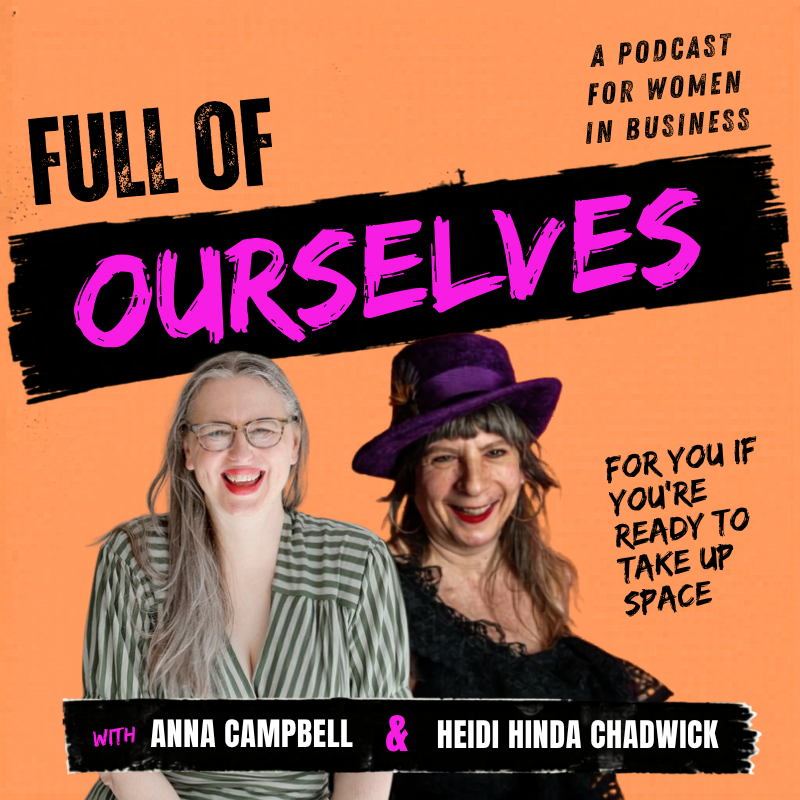
What would change if you started behaving as though you were the universe’s favourite child? In this episode of Full of Ourselves, Anna and Heidi explore self-abandonment, people pleasing and what happens when women stop orbiting everyone else and put themselves back at the centre of their own lives. We talk about self-trust, learning to receive, taking up space and why you don’t have to wait until you feel confident or ready. Plus, why jealousy can point towards what you really want and the power of asking a very different question: what if it all works out?
listen now
Here are the ways to listen to the podcast


watch this episode on youtube
Why You’re The Universe’s Favourite Child: The Antidote To Self-Abandonment
What would change if you started behaving as though you were the universe’s favourite child?
It sounds gloriously self-centred and possibly a little delusional. Definitely not the sort of thing many women have been encouraged to say out loud. And that is precisely why we, a podcast named Full of Ourselves, love it.
In this episode, Anna Campbell and Heidi Hinda Chadwick explore what it means to stop abandoning yourself in order to care for, support and gain the approval of everyone around you. Because being the universe’s favourite child isn’t really about believing the cosmos has singled you out for special treatment. It is about putting yourself back at the centre of your own life.
So many women have been conditioned to look outwards. We learn to notice what other people need, anticipate problems before they happen, over-give, seek approval and make ourselves useful. We can become incredibly good at supporting other people’s lives while we rarely stop to ask what we want from our own.
The antidote isn’t to stop caring about other people. It’s to stop disappearing from your own life in the process.
What does self-abandonment actually look like?
Self-abandonment doesn’t necessarily arrive as one huge decision to give yourself away. More often, it happens through hundreds of perfectly reasonable-looking choices.
You make the sensible decision because it will keep everyone happy. You put your own plans off because someone else needs you. You don’t say what you really want because you know it might create tension. You become the dependable one, the supportive one, the woman who can always be counted on. And there can be a lot of pride and identity wrapped up in being that person.
The problem comes when being useful to everyone else becomes more familiar than knowing what you want yourself.
You can reach a point where you’ve spent so long looking outwards that the questions What do I like? What do I want? What would I choose if nobody else had an opinion? become surprisingly difficult to answer.
Heidi talks in the episode about a realisation she had that she had been “waiting in the wings” of her own life. She uses the image of a stage and asks whether we are actually pressing the big red button for the thing we truly want, or pressing the safer button beside it because the real desire would require us to be more visible, exposed or brave.
It’s such a useful question to sit with. Are you building the life you genuinely want, or the version of it that feels most acceptable?
Putting yourself first isn’t the same as being selfish
Part of what makes self-abandonment so easy is that women are often presented with a false choice. You can be kind, caring, generous and available to other people, or you can be selfish and self-centred. There seems to be very little cultural space between the two.
But why can’t both things be true?
Why can’t you care deeply for the people you love and still believe that your desires matter? Why can’t you be generous and have boundaries? Why can’t you support somebody else and also be ambitious for yourself?
Heidi talks about the martyr archetype many women recognise: the woman with an apparently endless supply of goodwill, care and availability for everybody around her. From the outside, that can look beautifully selfless. On the inside, it can look much more like exhaustion, resentment and a growing awareness that your own life keeps being postponed.
Putting yourself at the centre doesn’t mean abandoning everyone else. In fact, it asks you to take greater responsibility for your own life. What do you want? What matters to you? What do you want to create, experience, change or become? What are you no longer willing to sacrifice simply because somebody else might prefer you to stay the same?
And sometimes answering those questions means becoming willing to disappoint people.
What if you stop waiting to feel ready?
Another form of self-abandonment is waiting.
Waiting until you feel confident enough. Waiting until someone chooses you. Waiting for another qualification. Waiting until you know enough. Waiting until the risk disappears. Waiting for somebody else to tell you that yes, you are allowed to go for it.
The problem is that confidence rarely arrives before the action.
Anna talks in the episode about why she is much more interested in self-trust than self-confidence. You don’t need to know that everything is going to work. You need to trust that whatever happens, you will be able to deal with it.
That self-trust is built from evidence. Every time you have moved forward without knowing exactly how things would turn out, you have figured something out. You have solved problems, changed direction, asked for help, learned something, recovered from mistakes and made the next decision.
Self-trust says: I don’t know exactly what will happen, but I trust myself to deal with what comes next.
That is very different from waiting until fear disappears.
Your brain is going to ask “what if?” anyway
Our brains are extraordinarily talented at offering us catastrophic possibilities.
What if I embarrass myself? What if nobody wants it? What if they think I’m ridiculous? What if I fail? What if I make the wrong decision?
Heidi suggests playing with those questions rather than trying to stop them altogether. Your brain is going to ask what if? anyway, so give it some different possibilities to explore.
What if contacting that person starts a brilliant conversation? What if applying for the opportunity leads somewhere unexpected? What if the thing you’re nervous about doing turns out to be incredibly enjoyable? What if even the experience that doesn’t “work” teaches you something you desperately needed to know?
Another phrase Heidi uses is It’s totally possible…
It’s totally possible that putting yourself first makes you happier. It’s totally possible that the people around you benefit from seeing you more fulfilled. It’s totally possible that the thing you keep dismissing as frivolous or unrealistic is actually something that matters enormously to you.
And then there is perhaps our favourite question of the episode:
What if it all works out?
We spend so much time rehearsing disaster that deliberately rehearsing possibility can feel almost rebellious.
Learning to receive without shrinking
Being the universe’s favourite child isn’t only about taking action. It’s also about receiving.
Think about what happens when somebody compliments you. Do you really receive it, or do you immediately bat it away?
Someone tells you your work is brilliant and you explain that it wasn’t really anything. Someone says you look fantastic and you point out something wrong with your outfit. Someone tells you that something you created made a difference to them and you rush to move the attention somewhere else.
We are so used to being told not to boast, not to be big-headed and not to think too much of ourselves that even receiving appreciation can feel uncomfortable.
Heidi challenges us to try something different. When someone gives you a compliment, let it land. And perhaps even amplify it.
Thank you. I’m really proud of that piece of work too.
Thank you. I feel great in this.
I’m so glad it resonated with you. I think this conversation really matters.
The universe’s favourite child doesn’t immediately throw the gift back.
You don’t have to make everything happen
There’s another part of this conversation that will probably feel familiar to a lot of capable women: the belief that if you want something to happen, you have to personally make every single part of it happen.
You have to organise it, push it, chase it, remind people, make the introductions, work harder and keep everything moving. If you take your hands off the wheel for even a second, surely everything will grind to a halt.
Anna brings in her Queen Bee metaphor here. The Queen Bee doesn’t fly around doing everything herself. She stays at the centre.
That doesn’t mean we sit at home and expect the universe to drop everything into our lap. We still have to take action. We write the article. We make the application. We have the conversation. We put our work into the world.
But we can also leave some room for the response.
Sometimes someone shares your work with a person you’ve never met. An opportunity appears through a completely unexpected connection. A conversation leads somewhere you hadn’t planned. Something comes back to you that you could never have manufactured yourself.
Heidi describes the universe’s favourite child as playful, curious, responsive and receptive rather than permanently hustling and trying to force an outcome.
There’s a big difference between taking responsibility for your life and believing you must control every detail of it.
What kind of universe are you creating?
Perhaps that is the real question underneath the whole episode.
Not whether you literally believe you are the universe’s favourite child, but what changes when you start behaving as though you matter inside your own life.
What belongs in your universe? What no longer does? Who gets access to your time and energy? What are you no longer available for? Which parts of yourself have been sitting in the wings for long enough?
You don’t have to include every person, demand, expectation or opinion simply because you’ve learned that doing so makes you a good person. You get to choose more than that.
Being the universe’s favourite child doesn’t mean believing you are more important than everyone else. It means no longer automatically believing that everybody else is more important than you.
It means remembering that your wants can exist alongside your responsibilities. That caring for other people doesn’t require abandoning yourself. That you are allowed to take the compliment, wear the dress, make the application, take up space, change your mind, say no, delete the comment, ask for more and press the button you actually want to press.
And maybe, when something wonderful does arrive, instead of immediately explaining why you don’t deserve it, you can simply say:
Thank you. More please.
Listen to the Episode
Listen to Why You’re The Universe’s Favourite Child: The Antidote To Self-Abandonment on the Full of Ourselves podcast with Anna Campbell and Heidi Hinda Chadwick for more on self-abandonment, people pleasing, putting yourself first, building self-trust, learning to receive and creating a life that actually revolves around you.
useful links
More info - the podcast
Follow us on Instagram @fullofourselvespodcast
Connect with Anna Campbell
https://www.goodgirlrebellion.com/
Instagram @annaccampbell
Anna’s book Good Girl Rebellion: Build the Business, Break the Rules, Be Limitless.
https://www.goodgirlrebellion.com/ggr-book
Connect with Heidi Hinda Chadwick
https://www.heidihindachadwick.com/
Instagram @heidihinda
Book: https://www.lemonjellypress.com/shop/p/the-story-of-the-deer-woman
To stay up to date with Heidi's book launch events: https://heidihinda.substack.com/
Thank you for listening. We hope you have enjoyed it. If you have, please do like and subscribe on your favourite podcast platform. This really helps us get the word out. And do tell everyone you know!
Also, we would LOVE to guest on podcasts and speak on stages all about women entrepreneurs. Get in touch! hello.fullofourselves@gmail.com